Capitals set to grow + $148k owner-investor gap + Enquiries reveal resilience


If you’ve been expecting Australia’s property market to stall, KPMG’s latest forecasts suggest otherwise.
The firm expects house prices to rise in every capital city during 2027, with Darwin forecast to lead at 4.6%, followed by Sydney, Brisbane and Perth (all 3.6%). Melbourne (3.3%), Canberra (3.0%), Adelaide (2.4%) and Hobart (2.4%) are also all tipped to post gains.
The key reason? Australia’s housing shortage hasn’t gone away.
KPMG believes higher interest rates and economic uncertainty will take some heat out of the market, but not enough to outweigh Australia’s limited housing supply.
A slower market isn’t necessarily a weaker one. For buyers, it can mean less competition and more negotiating power. For sellers, realistic expectations become more important than ever.
While the pace of growth may ease, the long-term fundamentals supporting Australian property remain firmly in place.

The $148,000 gap between owner-occupiers and investors
Owner-occupier suburbs have a habit of outperforming investor-heavy ones, and new Cotality research spanning sixteen years shows just how wide that gap can be.
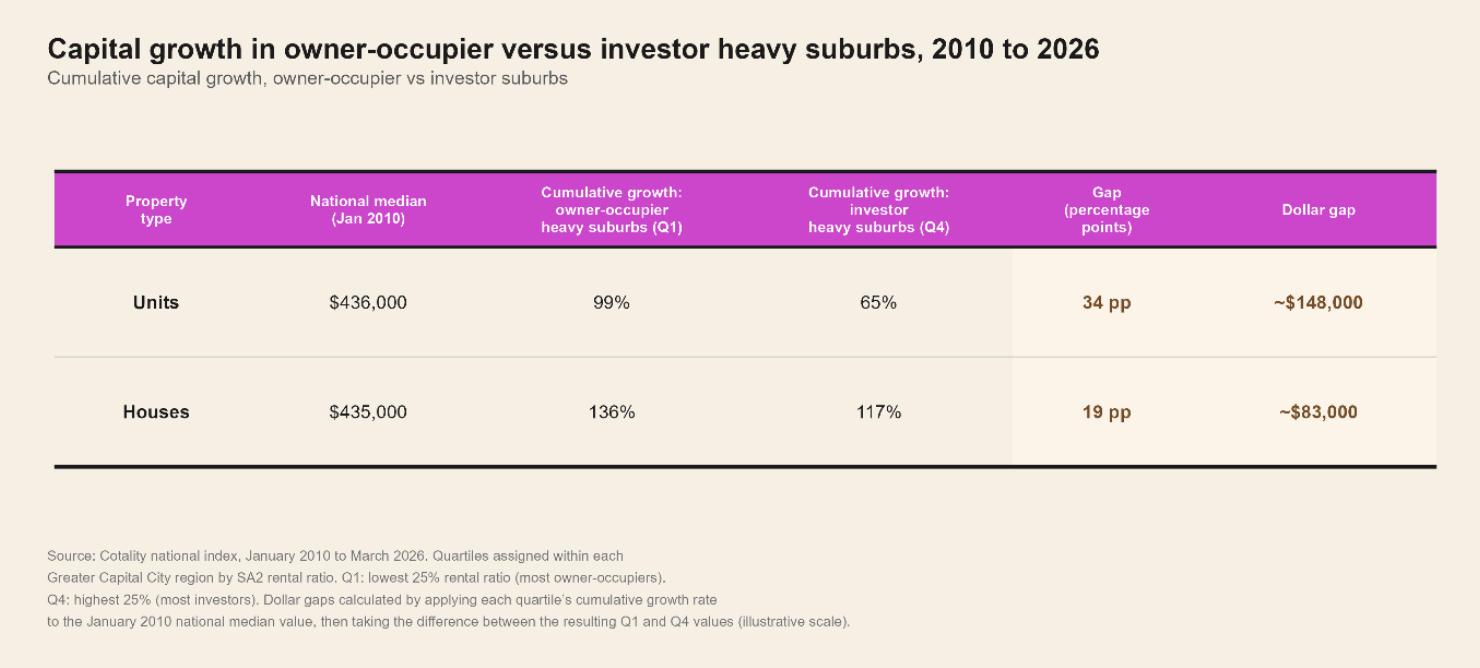
Between 2010 and 2026, units in owner-occupier-heavy areas grew 99% in value, compared to 65% in investor-heavy areas, a gap of 34 percentage points. Applied to the national median unit price of $436,000 in January 2010, that works out to around $148,000.
So why the difference? Investors typically buy for financial return rather than lifestyle, so they respond more strongly to price signals already in motion, often arriving after much of an area’s growth has happened.
Owner-occupiers behave differently. They will often pay a premium of $50,000 or more to be inside a good school zone or near a station, because they use that value every day for years. Investors assess the same property purely on achievable rent.
The result is that owner-occupier areas tend to capture more of each growth cycle, while rental yields constrain investor-heavy areas. The effect is strongest in the unit market (see image).
What buyer enquiries reveal about market resilience
Prices tell you what has already happened in a market. Buyer enquiries can tell you what’s coming next.
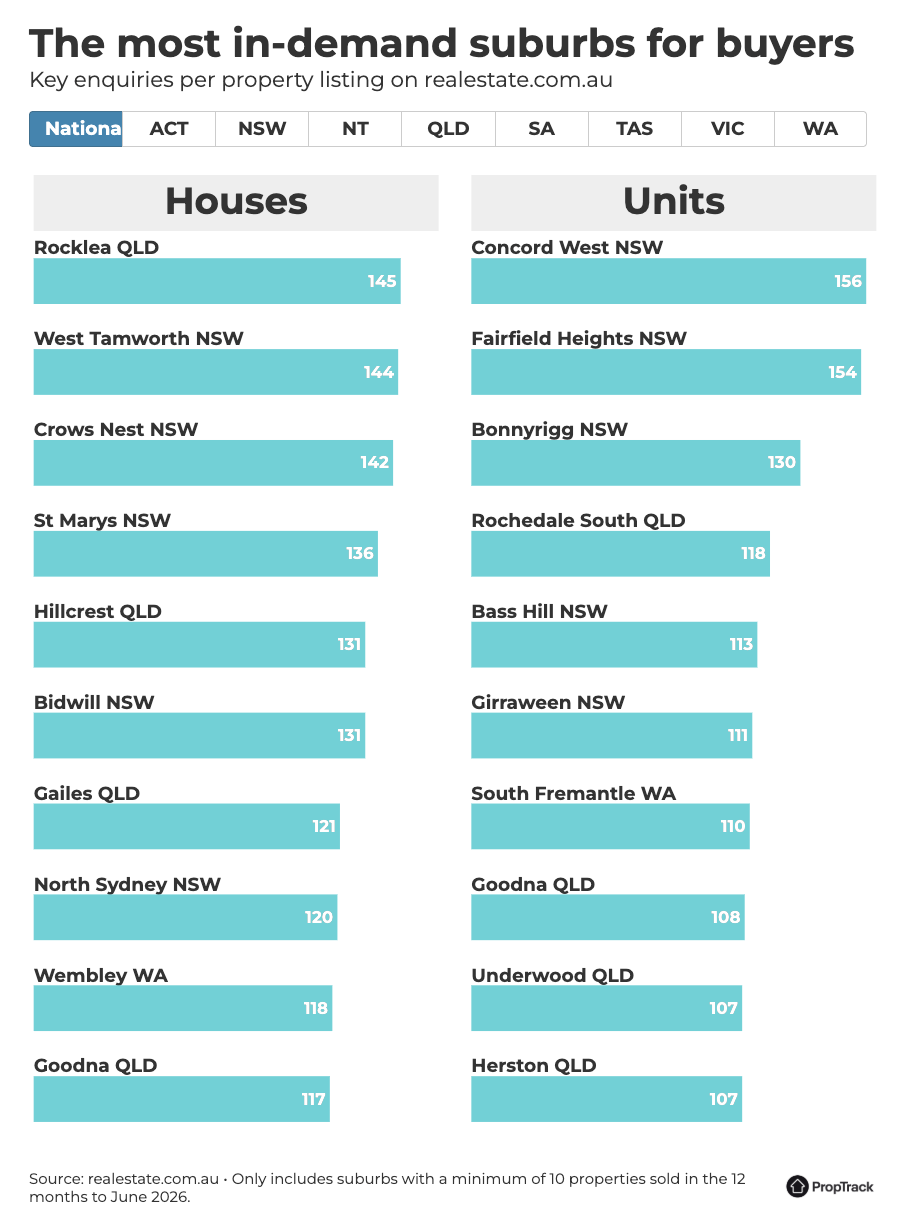
PropTrack’s latest data, covering the year to June 2026, tracks key enquiries per listing, capturing high-intent actions like emailing an agent or downloading a contract, to gauge genuine buyer interest at the suburb level.
According to REA Group senior economist Anne Flaherty, suburbs with the highest enquiry volumes tend to hold their value best, even as broader conditions soften. “Even if we see more buyers are hesitant and more people pull out of buying, you’re still leaving quite a higher number of people, so that maintains competitive conditions in those markets,” she said.
Notably, many of the highest-enquiry suburbs identified in the report are also relatively affordable, spanning western Sydney, southern Brisbane and parts of Perth.
For buyers and investors alike, demand data can be just as telling as price data.